
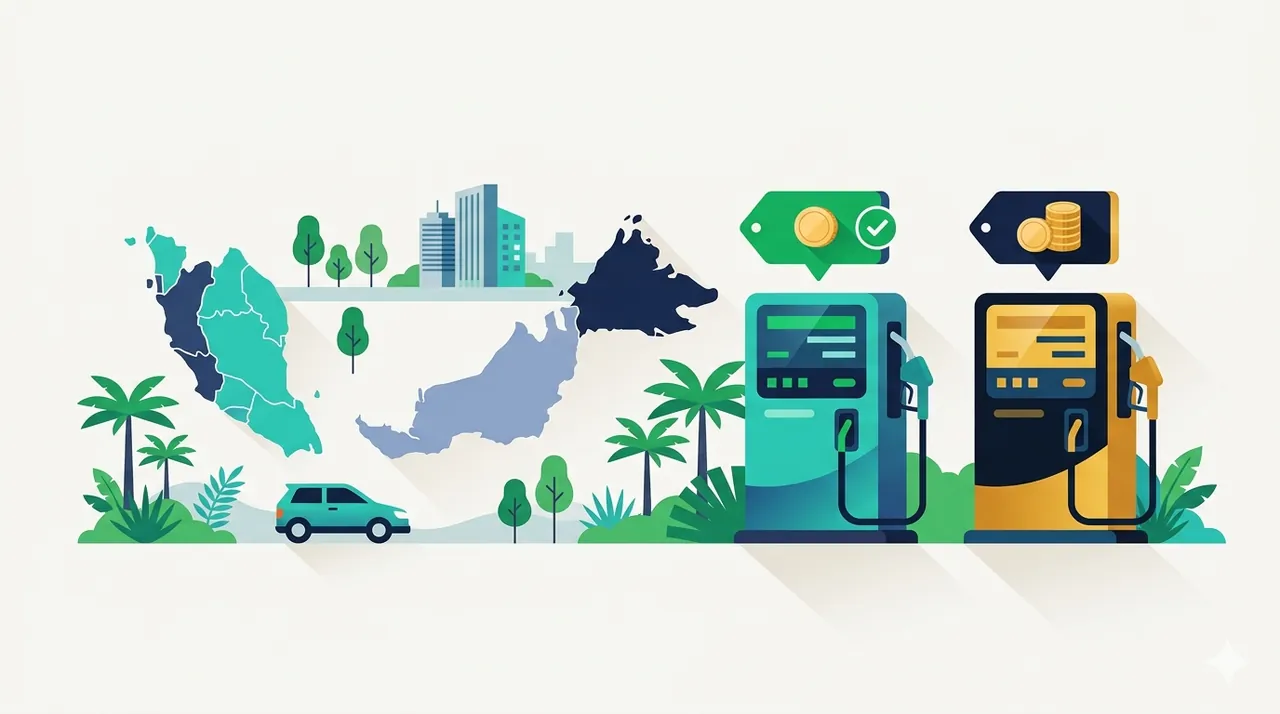
Before 1 July 2026, if you drove from Kota Kinabalu to Sandakan and stopped at a petrol station, you'd be surprised to see diesel priced far lower than in Kuala Lumpur or Johor. Back then diesel in Peninsular Malaysia followed the market price (now RM 5.07/litre), while in Sabah and Sarawak it was held at a fixed subsidised rate of around RM 2.15/litre — a gap of almost RM 2.92 per litre.
Why was there once such a big difference, and why did it end? The answer involves history, government policy, and regional economic considerations.
What Changed on 1 July 2026
This dual-price system has now ended. Diesel is sold at a single market price nationwide, with the subsidy delivered by who you are rather than where you fill up:
- Eligible individuals pay RM 2.10/litre through BUDI Diesel, verified with a MyKad at the counter (a 300-litre monthly quota since 1 September 2026, shared with BUDI 95).
- Registered commercial vehicles pay RM 2.15/litre through SKDS and a Fleet Card.
- Everyone else (including foreigners and ineligible company vehicles) pays the full market price.
The old Sabah/Sarawak special rate no longer exists — the subsidy is now tied to your eligibility, not your location. The sections below describe the former system for context.
The Old System: Two Different Pricing Systems
Malaysia actually has two diesel pricing systems:
- Peninsular Malaysia: Prices follow the APM formula and change weekly with global markets
- Sabah & Sarawak: Fixed subsidised price (administered by the government), typically RM 2.15/litre for many years
Why Diesel Subsidies in Borneo?
Subsidised diesel in Sabah and Sarawak has existed for decades, for several reasons:
- Rural economy, many interior areas rely on diesel for power generation, agricultural machinery, and boat transport. Without subsidy, the cost of living would skyrocket.
- Fishing industry, fishermen use diesel for their boats. Low prices are critical for this industry's viability.
- Distance & logistics, transporting goods in Sabah and Sarawak is harder and more expensive. Cheap diesel helps offset those costs.
- Regional equity policy, the federal government maintains the subsidy as part of its regional development commitment.
Impact on Consumers
For diesel vehicle owners in Borneo, this subsidy means huge savings, over RM 4,500 per year for a driver using 100 litres per month. For transportation and fishing industries, it's the difference between profit and loss.
However, the subsidy also creates an issue: diesel smuggling. Borneo diesel is sometimes smuggled to neighbouring regions or resold to unauthorised vehicles. The government has introduced control cards and purchase limits to address this.
How Smuggling Is Controlled
To prevent subsidy abuse, the government has introduced several control measures in Sabah and Sarawak:
- SKDS (Subsidised Diesel Control) cards, commercial diesel vehicle owners must register and use this card to access the subsidised price. The card limits daily purchase volumes.
- Station quotas, each petrol station has a daily cap on subsidised diesel sales. Once the quota is reached, customers must buy at market price.
- KPDN enforcement, the Ministry of Domestic Trade conducts routine raids in border areas and at stations suspected of channeling diesel to smugglers.
Despite these measures, diesel smuggling to neighbouring countries (especially Indonesia) still occurs. In 2023-2024, the government estimated diesel smuggling losses at RM 4 billion a year.
What's Different Beyond Price
There are also operational differences that new users in Borneo may not know:
Selling stations: Not all petrol stations in Sabah/Sarawak sell subsidised diesel. Some only sell market-price diesel (for tourists and Peninsula-plated vehicles). Look for the "Subsidised Diesel" signage at the station front.
Refill timing: Rural stations may run out of subsidised diesel on weekends as the weekly quota is exhausted. Lorry drivers typically fill up early in the week.
Out-of-state vehicles: Drivers with Peninsular Malaysia plates visiting Sabah/Sarawak can still buy subsidised diesel (for private vehicles, not commercial), subject to station limits.
This dual diesel pricing system reflected Malaysia's geographic and economic realities for decades. It wasn't perfect, and since 1 July 2026 it has been replaced by a targeted MyKad-based subsidy — but it acknowledged that Sabah and Sarawak had different needs than the Peninsula.